




Responsible supplementation. Not every flow rate corresponds to the same dose—what is FiH₂ in hydrogen inhalation?.
How much hydrogen do you actually inhale? Why does the fraction matter, rather than the „number of milliliters per minute”?”
Maybe you’ve heard about hydrogen inhalation from your physical therapist, or you’ve seen an ad for it on social media. Almost always, the first thing that catches your eye is a single number: flow rate. 600 ml/min, 1,000 ml/min, 1,500 ml/min, and sometimes even more. The answer to the question that automatically pops into your head seems obvious. More = better. Except that’s not the right question.

Imagine you’re making juice from syrup. You pour the same spoonful of syrup into a small glass one time and into a large bucket of water another time. „The amount of syrup is identical, but the taste is completely different—because it’s the concentration that matters, not how much syrup you poured in.” It’s the same with hydrogen. What matters to your body isn’t how much gas the device releases per minute, but how much of it ends up in the air you actually breathe in.
This „part” has a name: FiH₂
FiH₂ (from English fraction of inhaled hydrogen) refers to the fraction of hydrogen in the inhaled air—that is, the very „concentration,” or the percentage of hydrogen in the mixture that enters your respiratory tract. This is what comes closest to what we would call the actual dose.
And here’s something that’s rarely mentioned: the same flow rate in ml/min doesn’t mean the same dose for every person. A child breathes differently, a petite person breathes differently, an athlete after exercise breathes differently, and someone breathing calmly on the couch breathes differently. The same amount of gas mixes with a different amount of air in each person, so it will result in a higher hydrogen fraction in one person and a lower one in another. The label „600 or 1500 ml/min” on the device alone does not settle this issue.
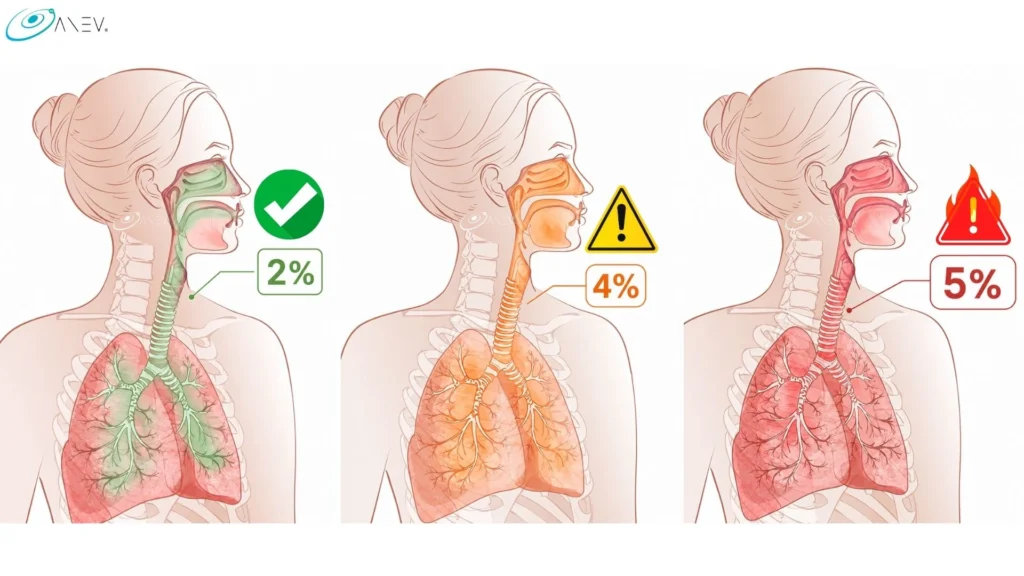
A hydrogen concentration exceeding 4% carries an inherent risk of ignition, which increases with flow rate (especially when FiH2 exceeds 4%); therefore, such configurations should be avoided.
Tyler W. LeBaron, „Respiratory-physiology modeling of therapeutic hydrogen inhalation: defining the fraction of inspired hydrogen (FiH)2) and flow-rate requirements”

That is why scientists are now proposing to reframe the question. Instead of asking, „How much gas does the device produce?” it is better to ask, „What is the actual percentage of hydrogen in what I’m breathing in?”. LeBaron et al. (2026) propose that FiH₂ be used as the primary parameter for hydrogen dosing. Just as in oxygen therapy, doctors use FiO₂, or the oxygen fraction. Interestingly, the authors point out that it is the fraction—not the breathing pattern itself—that determines the concentration of hydrogen in the tissues: rats and humans inhaling 2% hydrogen achieve similar concentrations, even though they breathe completely differently.
More doesn't mean better.
Research does not suggest that „the more, the better.” Rather, a practical reference point is around 2% FiH₂ (and, more broadly, a range of approximately 1–4%), rather than the maximum possible values. There is also a second reason why chasing higher numbers doesn’t make sense: above about 4%, hydrogen in the air becomes flammable. Forcing the flow rate higher, therefore, does not automatically provide benefits and may unnecessarily increase technical risks.
It's the dose that makes the poison.
Paracelsus
It’s worth recalling here Paracelsus’s old, common-sense principle: „The dose makes the poison.” Molecular hydrogen itself is a non-toxic gas that is well tolerated, and the body simply exhales any excess. But just because it’s biologically safe doesn’t mean that every flow rate is equally good for everyone.
Why are we writing about this?
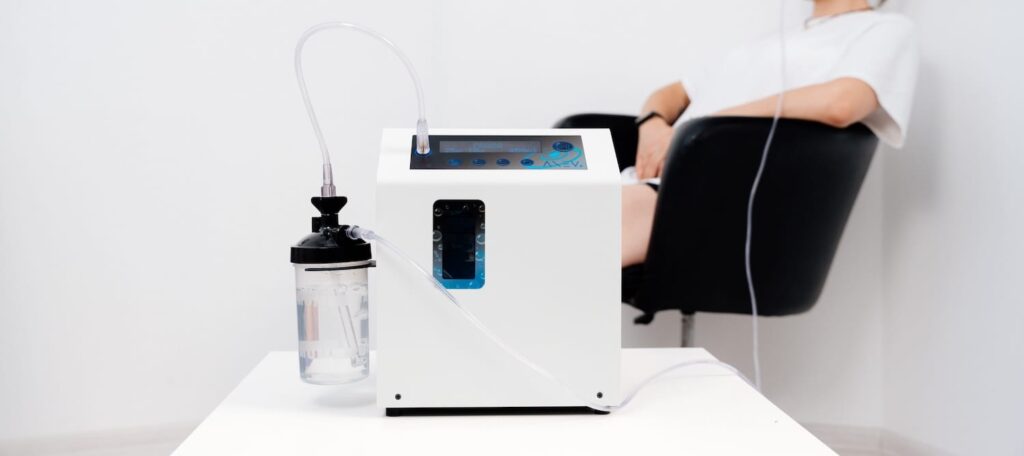
At ANEV, we design hydrogen inhalation systems centered on the correct dose and controlled flow. Our device generates a mixture of 67% H₂ and 33% O₂, and the flow rate has been selected in accordance with the recommendations of international experts to support effective and safe hydrogen supplementation without unnecessarily increasing the risks associated with the gas’s flammability.
Molecular hydrogen is being studied, among other things, in the context of oxidative stress and inflammation, and we view it as a means of support and daily prevention, rather than a „miracle cure” or a way to cure diseases. This is still a young and evolving field, which is why we rely on scientific data and responsible communication.
If you're considering a hydrogen inhaler for yourself, we'd be happy to explain how to interpret the flow rate, what FiH₂ is, and how to use hydrogen supplementation safely and in a way that's tailored to your individual needs.
Sources:
• LeBaron TW, Ohno K, Salomez-Ihl C et al. Respiratory-physiology modeling of therapeutic hydrogen inhalation: defining the fraction of inspired hydrogen (FiH₂) and flow-rate requirements. Respir Res. 2026. doi:10.1186/s12931-026-03664-9.
• Ohsawa I et al. Hydrogen acts as a therapeutic antioxidant… Nature Medicine. 2007;13(6):688–694.
• Johnsen HM, Hiorth M, Klaveness J. Molecular Hydrogen Therapy — A Review of Clinical Studies and Outcomes. Molecules. 2023;28(23):7785.
Joanna Macioł,
hydrogen and regeneration expert
+48 733 493 710
Check out our generator
Popular Posts
- FiH₂ Instead of ml/min – How to Administer Hydrogen Responsibly in a Clinic

- Responsible supplementation. Not every flow rate corresponds to the same dose—what is FiH₂ in hydrogen inhalation?.
- Hydrogen users: „My asthma has cleared up, and I’m sleeping through the night”
- Research Study at the University of Physical Education in Katowice: Take Part and Test Your Fitness!
- Project: Longevity – 1st Longevity & Anti-Aging Conference for Patients.





 Hydrogen users: „My asthma has cleared up, and I’m sleeping through the night”
 FiH₂ Instead of ml/min – How to Administer Hydrogen Responsibly in a Clinic