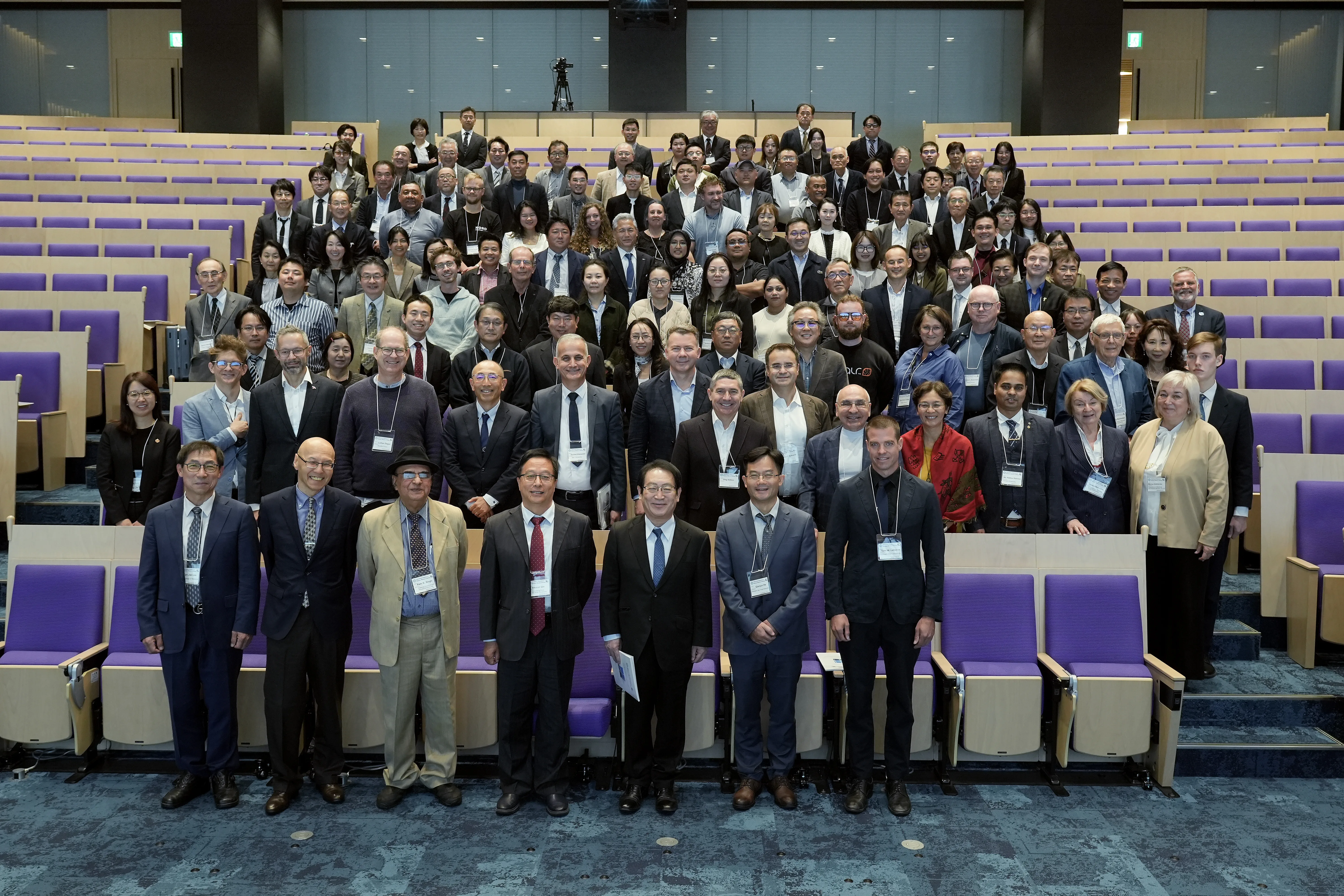
Participants at hydrogen conference in Japan, November 2025 - joint photo in the auditorium.
International Hydrogen Medicine & Biology 2025 Conference in Tokyo.
An important benchmark in assessing the direction in which the field of molecular hydrogen research is developing. The event brought together participants from 28 countries and regions, and the program included 46 presentations and scientific discussions.
The event was hosted by Shigeo Ohta and Suga Kato, performing the functions of Conference Chair i Secretary General International Hydrogen Medicine & Biology 2025 Conference in Tokyo.
It is worth mentioning that the conference was a combined event - it was held concurrently as a 5th annual conferenceInternational Society for Hydrogen Medicine & Biology and 14th Annual Conference of the Japanese Biomedical Society for Molecular Hydrogen. This combination strengthened the international nature of the meeting and facilitated the exchange of experiences between basic research, clinical practice and technological applications.
Particularly valuable was the meeting of academia with industry representatives - it is such cooperation that accelerates the ordering of knowledge, standardization of approaches and planning of future research projects. Our attention was also drawn to the strong presence of young scientists, whose energy and fresh outlook show that this direction has real prospects for development.
Our search for reliable knowledge about hydrogen applications took us to Japan, where we were able to confront assumptions with practice and science in the company of world pioneers. The most important thing for us is safety: working within clearly defined parameters, according to protocols and standards.
Sebastian Kuzminski, Tokyo 2025
At ANEV, we consistently focus on responsible approach: we track scientific data, promote dialogue between research and practice, and emphasize the importance of transparent protocols and security In working with hydrogen technologies.
This meeting reinforced one thing - hydrogen medicine needs more large, well-designed studies and transparent data. In the face of misinformation and marketing slogans We are building the future today based on EBM and responsible communication.
Key findings from the four plenary lectures (keynote) We have collected below in the form of short summaries.
ANEV team
Plenary lecture (Keynote 1) „Pharmacological effects of hydrogen and its effectiveness in treating diseases.”.
Motoaki Sano (Yamaguchi University Graduate School of Medicine)
Prof. Motoaki Sano's keynote showed how the translational research over hydrogen (from preclinical models to clinical trials) are developing especially in the area of Critical care, resuscitation and organ protection. Great emphasis was placed on delivery parameters, route of administration and pharmacokinetics, which is what realistically determines the quality and safety of interventions.
For years, we have been active contributors to the development of hydrogen medicine, moving the field from basic research to translational research in cardiovascular and renal disorders. Our work focuses on the therapeutic potential of molecular hydrogen (H₂) in protecting organs from ischemia-reperfusion injury, oxidative stress and inflammation.
A central theme of our study was the evaluation of hydrogen inhalation therapy in preclinical models of cardiac arrest and resuscitation. In rodent studies, administration of 2% hydrogen during cardiopulmonary resuscitation markedly reduced mortality and helped preserve neurological function. These results provided a strong biological rationale for moving toward clinical applications and drew attention to hydrogen as a new adjunctive strategy in critical care.
An important part of our study was hydrogen inhalation therapy in patients after successful resuscitation following cardiac arrest. Preclinical rodent studies have shown that inhalation of 2% hydrogen mixed with oxygen during resuscitation markedly improves survival and reduces neurological damage. These findings were translated into a multicenter, randomized, double-blind clinical trial in patients after out-of-hospital cardiac arrest. Prof. Mamoru Suzuki will discuss these results at the conference as an invited speaker.
In addition to evaluating efficacy, we extensively analyzed the pharmacokinetics of hydrogen in vivo. In large animal models, our team elucidated how hydrogen is distributed in the bloodstream following various delivery routes, including inhalation, infusion of hydrogen-enriched solutions and oral delivery. The study showed that systemic delivery comes with challenges such as dilution and lung excretion, highlighting the importance of optimizing both the route of delivery and the timing of administration. Such analyses have proven crucial in designing rational therapeutic protocols and understanding the limitations of hydrogen distribution in clinical settings.
In addition to research in the area of acute care, we also analyzed applications in nephrology. We co-developed innovative devices that dissolve hydrogen in dialysis fluids using capillary membranes for gas separation. This technology enables efficient, „bubble-free” delivery of hydrogen, which can help reduce oxidative stress and chronic inflammation in hemodialysis patients. These advances demonstrate hydrogen's potential not only in emergency medicine, but also in the long-term management of chronic diseases. I will talk about these results in a conference seminar.
Bottom line: our experience has helped solidify hydrogen medicine as a translational field - from laboratory discovery to clinical applications. The lecture will highlight the journey from basic research to clinical trials, current challenges in systemic delivery, and prospects for the development of hydrogen therapies in various areas of medicine, showing how rigorous experimental and pharmacological research can open the way to innovative therapies.
Biography (translation): Prof. Motoaki Sano graduated from Keio University School of Medicine and gained clinical experience at Keio University Hospital. From 2000, he worked at Baylor College of Medicine (cardiology) in the US for five years. After returning to Japan, he was a lecturer and then an associate professor in the Department of Cardiology at Keio University School of Medicine. In December 2023, he became a professor at Yamaguchi University. In 2017, he established the Hydrogen Gas Therapy Development Center at Keio University, focusing on innovative therapies using hydrogen inhalation. He specializes in internal medicine, cardiology, nephrology and anti-aging medicine. He has received numerous awards, including the Sato Award (Japanese Circulation Society), the Japanese Heart Failure Society Scientific Award and the Takayasu Mikito Award (Japanese College of Angiology).
COI / Funding: research support and scholarship donations and a joint patent application (Doctor's Man, Inc. and TAIYO NIPPON SANSO) were mentioned. Mention of a clinical trial: HYBRID II Trial (jRCTs031180352).
This lecture showed the „other side” of the H₂ world: agriculture and the food chain. The speaker discussed research and deployment results suggesting that hydrogen-based technologies can support Plant stress resistance, yield quality and post-harvest durability, while at the same time fitting in the direction of more sustainable agriculture.
Hydrogen is the most common element in the universe - accounting for about 75% of total mass. On Earth, molecular hydrogen (H₂) is found in a variety of environments (from extreme to urbanized) and plays important roles in numerous natural processes, especially in the biogeochemical cycles of hydrogen in the atmosphere, water and soil. H₂ metabolism in animals, plants and microorganisms should be considered an important factor affecting human health - especially in the context of the possible presence of genes with „hydrogen-forming” potential in the genomes of humans and other animals.
Recent studies have shown that H₂ can be used to significantly promote plant growth and development, increase stress resistance, increase yield and quality, and extend the shelf life of agricultural products. These benefits can promote reduced use of pesticides and fertilizers in crop production and food processing, as well as reduced post-harvest food losses - resulting in lower production costs and higher profits for farmers.
In China, hydrogen farming technologies have progressed from laboratory research to large-scale farm-to-supermarket trials. These trials include a variety of crops, including rice, strawberries, blueberries, tomatoes and grapes. Successful applications point to a promising future for hydrogen farming.
The concept goes beyond the mere production and processing of agricultural products and food. It envisions a future in which hydrogen energy and biology can be integrated with renewable energy sources, machinery and equipment manufacturing, crop and animal production, post-harvest storage and fixation, processing and transportation. Such integration could create a more comprehensive and sustainable hydrogen agriculture industrial chain.
Biography (translation): Prof. Shen Wenbiao is a full professor in the Department of Biochemistry and Molecular Biology (College of Life Sciences) at Nanjing Agricultural University (NAU) in China and founder of the Gasotransmitter Research Group. Since 2011, his early research indicated that molecular hydrogen (H₂) may act as a signaling molecule in plants, involved in development and responses to abiotic and biotic stresses. Over the past decade, the team has focused on hydrogen agriculture and the biological functions and signaling pathways of H₂ under controlled conditions. Field and laboratory research has attracted international interest and collaborations (including with Air Liquide). Currently, the main focus is the identification and functional analysis of regulatory genes and proteins related to hydrogen metabolism in plants (and more recently in animals). In 2025, the team described observations suggesting that H₂ production (induced by anaerobic conditions) may be a universal phenomenon in eukaryotic organisms, including humans and other animals, and hypothesized that hydrogen metabolism may have been previously underestimated. Prof. Shen has published more than 190 peer-reviewed papers in Molecular Plant, Current Biology, Plant Physiology, Plant Journal, among others.
COI: lack of.
Plenary Lecture 3 „Molecular hydrogen: a promising molecule in sports science and health promotion.”.
Michal Botek (Palacký University Olomouc, Czech Republic)
Prof. Michal Botek's keynote dealt with how H₂ would be studied in the context of the fatigue, recovery and exercise tolerance - both in trainees and in selected clinical populations (e.g., RA). The presentation strongly echoed the need for individualization of protocols (form of administration, dose, time) and study design in a randomized and blinded standard.
Introduction: The antioxidant, anti-inflammatory, anti-apoptotic and signaling properties of molecular hydrogen (H₂) have attracted increasing scientific interest over the past two decades. In addition, H₂ is sometimes indicated as a promising molecule with the potential to reduce fatigue and promote recovery in various types of activity (including sprinting, endurance running, strength training).
The main objective of our review of H₂ studies was to see if the administration of H₂ has a beneficial effect on performance and recovery during highly demanding plyometric exercise and tapering in a specifically trained population. An additional objective was to investigate the use of H₂ in healing therapy in patients with rheumatoid arthritis (RA).
Methods: All experiments were designed as randomized, double-blind, placebo-controlled parallel studies. H₂ supplementation was performed either by ingestion of hydrogen-rich water (HRW) (pH = 7.8; ORP = -652 mV; dissolved H₂ concentration = 1.3 ppm) or by inhalation of H₂ (300 ml/min; H₂ purity > 99.8%). The supplementation protocol differed between studies depending on the conditions. Performance measures, heart rate variability (HRV), subjective and objective measures of fatigue, and the Borg perceived exertion scale (RPE) were analyzed.
Results: Short- and peri-exercise „anti-fatigue” effects were observed after HRW ingestion during plyometric exercise and after a period of tapering. In addition, H₂ inhalation significantly increased the distance covered in patients with RA after spa therapy. With regard to recovery, H₂ supplementation showed a significant effect to promote recovery after plyometric exercise and after a period of overload preceding tapering. It was also found that H₂ supplementation significantly reduced subjective RPE, reduced the decrease in parasympathetic regulation of the heart, and improved exercise tolerance in RA patients.
Conclusions: Both acute (one-time) and chronic supplementation of H₂ appear to be effective strategies for promoting performance and recovery in various populations. Based on our results, it is reasonable to consider that H₂ could also potentially be used in the context of injury prevention associated with chronic fatigue or overtraining. At the same time, individualization of H₂ dosage requires further research.
Biography (translation, abbreviation faithful): Assoc. Prof. Michal Botek, PhD works at the Faculty of Physical Culture at Palacký University in Olomouc, specializing in exercise physiology and its applications in sports diagnostics, training management and health promotion. He works with professional sports (diagnostics and consulting on loads and recovery), and in parallel develops health promotion programs for people with obesity and chronic diseases, among others. For more than 20 years, he has been monitoring autonomic nervous system activity in athletes, using HRV as a non-invasive biomarker to optimize loads and prevent overtraining. In recent years, his team has extensively studied the effects of molecular hydrogen on the human body (rest, exercise, recovery), with particular emphasis on fatigue and recovery, oxidative stress, muscle damage, lactate response and perceived exertion. The team also pioneered applications of hydrogen inhalation in post-COVID-19 syndrome patients, and is a member of the Executive Board of the European Academy for Molecular Hydrogen Research in Biomedicine.
COI : The author is a board member of the European Academy for Molecular Hydrogen Research in Biomedicine and an external research consultant for H2World (Czech Republic). Testing requirements: indicated that published studies had ethics committee approvals; several unpublished studies (presented orally) were also listed, along with committee approval numbers.
Plenary Lecture 4 Hydrogen Medicine Materials (Hydrogen Medicine Materials)
Qianjun He (Shanghai Jiao Tong University).
The lecture dealt with what today is the „bottleneck” of H₂ development in medicine: How to measure hydrogen in the body in real time and how to deliver it precisely to your destination. The speaker proposed the concept of „Hydrogen Medicine Materials” - biomedical materials designed to facilitate controlled release and targeted delivery of H₂.
Hydrogen molecules exhibit broad antioxidant and anti-inflammatory activities, as well as pronounced biological effects and a high biosafety profile in the context of many inflammation-related diseases. Hydrogen therapy is emerging as a developing and promising therapeutic strategy. At the same time, hydrogen medicine is currently facing three major issues: (1) what are the fundamental principles of hydrogen therapy; (2) how to detect hydrogen molecules in vivo in real time; (3) how to efficiently deliver hydrogen to the target site.
We propose to define „Hydrogen Medicine Materials” as a new concept of biomedical materials specifically designed to overcome key challenges of hydrogen medicine. This includes, but is not limited to, exploring the bioeffects and mechanisms of H₂ through in vivo monitoring of H₂ transport, metabolism and metabolism, and enhancing therapeutic efficacy through high-throughput, locally targeted delivery and controlled release of H₂, etc.
In an attempt to solve these challenges, our team is conducting research on the principles of action, tool development and material applications, with a number of innovative results, including: (1) identification of the biological target of hydrogen molecules and description of the fundamental principles of H₂„s anti-inflammatory, anti-cancer and ”anti-aging" activities; (2) development of the first bio-trial (bio-probe) for H₂ and confirmation of H₂'s high ability to cross biological barriers; (3) development of a series of new biomaterials to deliver H₂ to increase delivery efficiency and application of these materials to treat serious, difficult-to-treat diseases. The speech will present achievements achieved in recent years.
Biography (translation): Dr. Qianjun He received his PhD in 2010 from the Shanghai Institute of Ceramics (Chinese Academy of Sciences), after which he worked there as an Assistant Professor. In 2012, he moved to the University of Leeds, where he received a Marie Curie Fellowship. After two years, he joined the Laboratory of Molecular Imaging and Nanomedicine at NIBIB, NIH (USA) as a postdoc. In 2015, he became a tenured professor at Shenzhen University. In 2022, he moved to Shanghai Jiao Tong University and became Professor (tenured) of Materials Science. He is currently Distinguished Professor at SJTU's School of Materials Science and Engineering. He is engaged in the engineering and development of advanced nanomaterials and nanomedicine for precision theranostics and hydrogen therapy for difficult-to-treat diseases. He has published more than 100 peer-reviewed papers (h-index 70) in Sci. Adv., Nat. Commun. and others. He is a recipient of the Outstanding Young Scientist Award (National Natural Science Foundation of China), and has also received a leadership award in molecular hydrogen research (European Academy for Molecular Hydrogen Research in Biomedicine, 2022). He is vice president of the International Society for Hydrogen Medicine and Hydrogen Biology and a member of the editorial board of Medical Gas Research. Author's website (from materials): https://www.x-mol.com/groups/he_qianjun?lang=en
The plenary lectures shared a common denominator: great potential for research, but also equally great responsibility for standards, methodology and parameters. It is in this balance - between curiosity and scientific rigor - that we see the future of hydrogen medicine.
To provide you with the best possible experience, we use technologies, such as cookies, to store and/or access information about your device. Consenting to these technologies will allow us to process data, such as browsing behavior or unique identifiers on this site. Failure to consent or withdrawal of consent may adversely affect certain features and functions.
Functional
Always active
Storage of or access to technical data is strictly necessary for the legitimate purpose of enabling the use of a specific service expressly requested by the subscriber or user, or solely for the purpose of carrying out the transmission of a message over an electronic communications network.
Preferences
Storage or technical access is necessary for the legitimate purpose of storing preferences that are not requested by the subscriber or user.
Statistics
Technical storage or access that is used exclusively for statistical purposes.Technical storage or access that is used solely for anonymous statistical purposes. Without a subpoena, voluntary compliance from the ISP, or additional records from a third party, information stored or retrieved solely for this purpose usually cannot be used to identify you.
Marketing
Storage or technical access is required to create user profiles for the purpose of sending advertisements or tracking a user on a website or on several websites for similar marketing purposes.











 Applications of hydrogen inhalers in prevention
 Karolina Szczepaniak: 72 hours in the water and a world record!